
HOW TO ANSWER IELTS SPEAKING PART 1 QUESTIONS
IELTS SPEAKING PART 1 – WHAT IS THE PURPOSE?
First of all, let’s think about this part of the test. What is it all about?
Part one of the speaking test is a short-form conversation between the speaker and examiner. The questions here will be quite simple and personal. You might be asked things like:
- What sort of movies do you like?
- Do you often play sports?
- What was the last book you read?
- Can you cook?
These are the sort of general questions that apply to pretty much everyone. You could answer them in one easy sentence… but that’s actually not a good idea. We’ll come back to that later.
The purpose of part one is ultimately to ease the candidates into the speaking test. As you probably know, the questions will get harder and harder over the course of the test. You can think of it like this:
| Part 1 | General questions | Easy |
| Part 2 | Long-form answer | Difficult |
| Part 3 | Abstract questions | Very difficult |
Thus, part one is in a sense a warm-up for the rest of the test. It is a way of letting you become accustomed to speaking face-to-face with the examiner. You can use this part of the test to get over your nerves and settle in, ready for the more challenging parts.
WHAT SORT OF ANSWERS SHOULD YOU GIVE?
For part one questions, you should give simple answers that are neither too long nor too short. For example, imagine you are asked, “Who is your best friend?” An answer that is too short would be:
- My best friend is Jeremy.
This is not very good because, although you have shown that you understood the question, you have not really demonstrated much ability in terms of English use.
However, giving answers that are too long is also not the best thing to do:
- My best friend is a guy called Jeremy. I met him back in the summer of 2006 when we were both in high school. It was a warm evening and we were both looking for something to do. He was wearing a Pearl Jam T-shirt and at that time I was really into them, so I said something like, “Hey, man, do like Pearl Jam or is it just a fashion thing?” He laughed and said that he was into their music…
Actually, this is a good story but the problem is that you are saying too much. Remember that the more you say, the more likely it is that you will make a mistake and that each mistake can count against you. Consider that, in the IELTS speaking band descriptors, it specifically mentions the number of mistakes made, and therefore you should always think about limiting this.
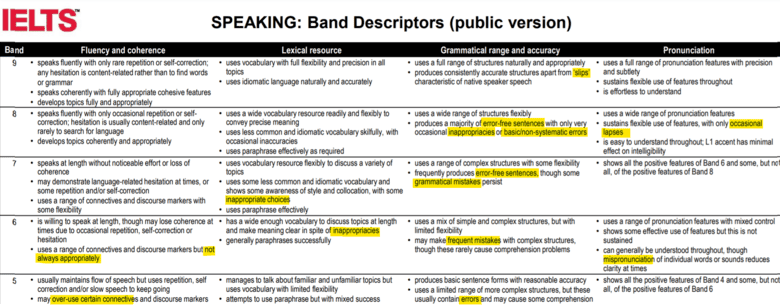
Thus, it is worth giving answers that fully answer the question but without saying too much. This gives you a better chance of giving an error-free sentence.
Considering that…
HOW SHOULD YOU ANSWER PART 1 QUESTIONS?
My advice to students is to do the following:
- Answer the question.
- Explain your answer.
This could be two or three or four sentences. It doesn’t matter, really. Just answer it directly and then give some explanation.
Taking the “best friend” question from above, I might reply:
- My best friend is a guy called Jeremy.
- We met when we were in high school and stay in touch all these years later. He’s always been someone I can count on and confide in.
Here, I have given a simple, direct response to the question, then developed it with two more sentences. I have not said too much, which is important, but I have said enough to incorporate some topic-specific vocabulary, such as “stay in touch,” “someone I can count on,” and “confide in.” Remember that for IELTS you should aim to use language that is specific to the given topic. (You can learn more vocabulary about friendship here.)
Here is another example.
Question: What sort of movies do you like?
I like different kinds of movies but I suppose comedies are my favourite. Although serious movies are great, sometimes you get to the weekend and just need a laugh. Even the dumbest of comedies can wash away the stress of a difficult week.
Again, this answer had three sentences, although it probably would have been fine with two. I have answered directly (stating comedies) and then explained (saying why comedies are my favourite). I have tried to make my ideas clear using natural language.
SUMMARY
When it comes to IELTS speaking part one questions, you should aim to give answers that are neither too short nor too long. Begin by answering the question directly, then giving some sort of explanation. Even if you are confident in your skills, don’t drag your answers out too much. Remember that you will have plenty of chances to show off later! The questions in parts two and three will allow you to give longer answers, so at this point just keep it simple and get comfortable speaking with the examiner.
If you want to practise your IELTS speaking skills, check out my practice speaking tests here. This is a half-hour session where we go over a standard speaking test and then discuss your performance.