
How to do Part 2 of the Speaking test
In Part 2 of the speaking test, you need to speak for between 1 minute 40 seconds and 2 minutes. If you manage to get to 1 minute 40 seconds and stop, the examiner can continue the test and move onto Part 3. This is a new change in the speaking test that started this year. But, you should try to get to 2 minutes.
So, what do you have to do?
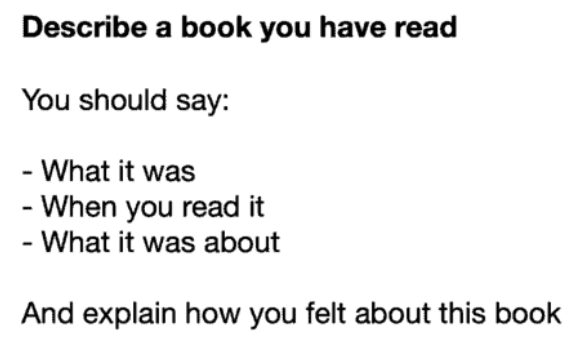
Let’s use this one as an example.
The examiner will give you your topic and a piece of paper and then they will say
“You have 1 minute to prepare”
From this moment, the examiner is timing 1 minute and they cannot speak.
In this 1 minute, you need to
- make some notes (just words) for each point.
- once you have words for each one, go back and add details (again, words only)
- if you have a few seconds, compose yourself, breathe, relax!
The examiner will say “Remember, you have 1 to minutes for this so don’t worry if I stop you. Can you start speaking now please?” and this is your cue to start speaking.
Now, what some people do is go through the first 2 points in the first 10 seconds!! They say something like
“I’m going to talk about a book called The Lord of the Rings. I read it when I was at school”
So, now, you only have 2 points left to talk about.
What you should do is develop each point as much as you can. Say something like;
1 What it was
“I’m going to talk about a book called The Lord of the Rings. I know most people have probably seen the films that came out a few years ago, but not many have actually read all the books, which I think is a shame. It’s actually a collection of 3 books so the whole story is thousands of pages long”
As you can see, this is just the first point so it is now much easier to speak for longer.
This is what you need to do to be able to speak for 2 minutes.
Another thing you can do it tell an anecdote (a little story about the topic). For example
2 When you read it
“Well, I read it for the first time when I was at secondary school. It was part of our English course and nobody was interested in it, especially when we saw how many pages the books had. I remember one of my classmates complaining that they would never be able to finish the books in the time we had, but strangely enough, once we started reading it in class and talk about the story, everyone got really involved with the story”
What this does is two things.
One – it makes it easier to talk for longer as you are talking about something that actually happened.
Two – you have to use a much wider range of vocabulary and grammar.
Now you can move onto the third and fourth point and the examiner will probably stop you because you have spoken for 2 minutes; congratulations.
Remember, the examiner will ask you a follow up question. Usually it’s “Have you told other people about ………?”
Why is part 2 important?
Part 2 is important because it shows the examiner whether you can speak on your own for an extended period of time. It’s also the only time in the exam when the examiner can relax and listen to you without having to prepare for the next question, so they can listen very carefully.
What also happens here is that the examiner chooses what questions to ask you in Part 3, based on your performance in Part 2. If you do well and show you can speak at length, the examiner will give you the more challenging questions in Part 3 and this means you can get Band 7+. If they ask you the easier questions, then you cannot get into Band 7.
So, now what? Well, if you are going to do IELTS, get an IELTS examiner, like me, to do an online IELTS speaking test with you. I will give you your score for each Band and explain why you are getting this score. Then I will show you what you need to do to get higher marks.